
Home / Paper weight explained
Printing guide
Paper weight explained: lb, gsm and pt
Paper weight tells you how heavy and stiff a sheet is. US pounds (lb) are the weight of 500 sheets at a base size that differs by paper type, so 80 lb text is thin and 80 lb cover is stiff. Grams per square meter (gsm) is one scale for every paper. Points (pt) measure thickness in thousandths of an inch.
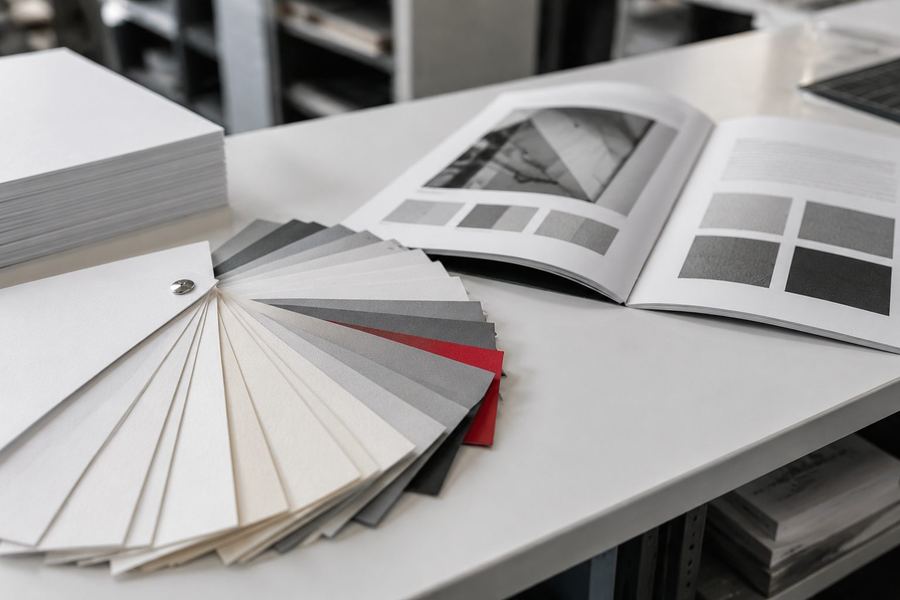
Paper weight chart: lb to gsm
The same pound number means different things on bond, text and cover paper. The gsm column is the one that lines up.
| 20 lb bond | 75 gsm. Everyday copy paper |
|---|---|
| 24 lb bond | 90 gsm. Better letterhead and reports |
| 28 lb bond | 105 gsm. Heavy letterhead, resumes |
| 32 lb bond | 120 gsm. Premium letterhead |
| 60 lb text | 89 gsm. Light flyers, book pages |
| 70 lb text | 104 gsm. Flyers, newsletters |
| 80 lb text | 118 gsm. Brochures, catalog pages |
| 100 lb text | 148 gsm. Premium flyers and brochures |
| 65 lb cover | 176 gsm. Light cardstock, folders |
| 80 lb cover | 216 gsm. Postcards, greeting cards |
| 100 lb cover | 270 gsm. Heavy postcards, covers |
| 110 lb cover | 298 gsm. Business cards, sturdy covers |
| 130 lb cover | 352 gsm. Extra heavy cards |
Bond, text and cover: why 80 lb is not always 80 lb
The pound rating is the weight of 500 sheets of the paper's base size before it is cut down. Bond paper is weighed at 17 by 22 inches. Text paper is weighed at 25 by 38 inches. Cover paper is weighed at 20 by 26 inches. Because the base sheets are different sizes, 80 lb text (118 gsm) is a flexible brochure paper while 80 lb cover (216 gsm) is a stiff postcard stock.
Gsm fixes the confusion. It is the weight of one square meter of the paper, no matter the type. When two quotes list different pound ratings, convert both to gsm and compare.
Points: thickness, not weight
Cardstock is often sold by thickness in points. One point is one thousandth of an inch, so 14 pt stock is 0.014 inch thick and 16 pt is 0.016 inch. Points describe the feel in the hand better than weight does, which is why business cards are quoted in points.
A 14 pt card is roughly 110 lb cover and a 16 pt card roughly 130 lb cover, though the match varies by stock, since points measure thickness and pounds measure weight. Coating changes the feel too: a gloss coat makes the same sheet feel slicker and a little thinner than a matte coat.
Which weight for which job
Pick the weight by what the piece has to survive. A flyer handed out once needs 70 to 100 lb text. A brochure that gets folded wants 80 or 100 lb text so the fold stays clean. A postcard that goes through the mail needs at least 0.007 inch thickness for the Postal Service at sizes up to 4.25 by 6 inches, and 0.009 inch for larger cards. 14 pt cover clears both. Business cards run 14 or 16 pt. Letterhead runs 24 to 28 lb bond or 70 lb text.
| Flyers, handouts | 70 to 100 lb text |
|---|---|
| Brochures, tri folds | 80 or 100 lb gloss or matte text |
| Postcards, mailers | 14 pt cover |
| Business cards | 14 pt matte, 16 pt gloss, or uncoated cotton |
| Letterhead | 24 to 28 lb bond, 70 lb text |
| Booklet covers, folders | 80 to 100 lb cover |
| Booklet inside pages | 60 to 80 lb text |
Paper at our shop
Ask us which stocks are on the shelf for your job, and come feel the samples at the counter on Ventura Boulevard before you decide. Files in by 10 AM are usually ready by 3:30 PM the same day.
Quick answers
People also ask
75 gsm. That is standard copy paper.
80 lb cover is thick, about postcard weight. 80 lb text is not, it is brochure paper. Same number, different base sheet.
Cardstock starts around 65 lb cover (176 gsm) and runs up to 130 lb cover (352 gsm). Business cards use 14 or 16 pt, which is around 110 to 130 lb cover.
0.014 inch thick. Points measure thickness, not weight. It is the standard business card stock.
100 lb text for a flyer that should feel substantial, 70 lb text for a cheaper handout. Both print the same day here.
Print it here
What this guide leads to
More printing guides: